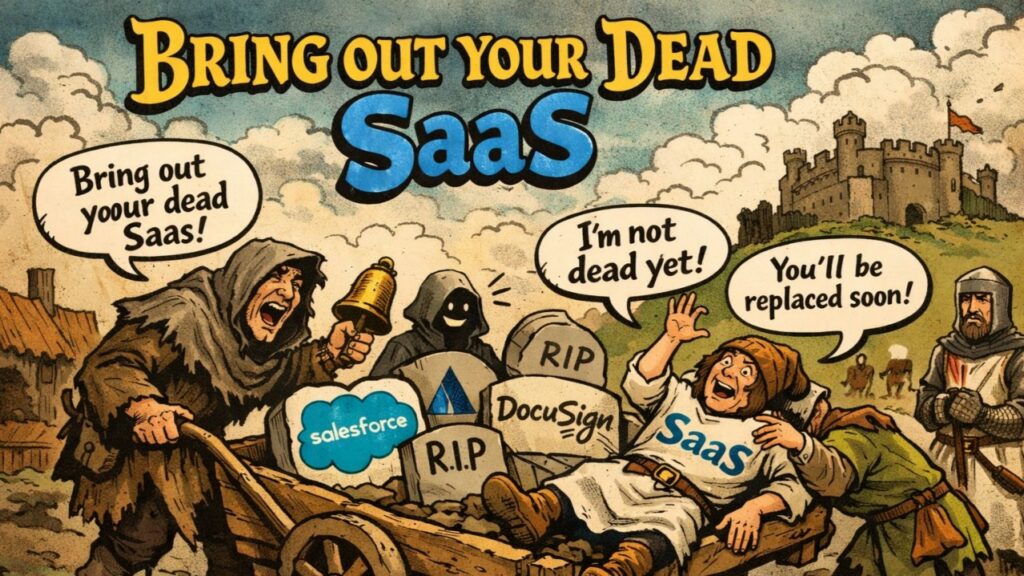
Bring out your dead SaaS
If you haven’t noticed: since the beginning of the year, an apocalypse has supposedly been underway. AI prophets foretell doom, and the market listens: no more SaaS companies, no more software producers, all the market darlings of the cloud boom are doomed. Salesforce, Atlassian, Workday and even Docusign were all hit. Over the last 365 days, they lost between 25% and 41% of their market value, with most of that drop happening in the last 2–3 months. And all of this is supposedly because of AI — because “AI will replace everything.”
It certainly looks that way. All the signs seem to be there:
- new AI tools based on LLMs let people create software without writing a single line of code,
- AI agents can do it all for you; you just need to tell them what to do (and give them full access to your environment and desktop).
It is a tempting story. But, as usual, it is too good to be true.
Reality is a bit different. Less colorful for AI companies, but more colorful for existing SaaS companies.
Why AI impacts SaaS/software companies
Fallacies
“Everybody can build their own Salesforce now”
Yes, but… why?
Writing code is only a small fraction of the total cost of designing, building, maintaining and using software. Various analyses estimate that writing code accounts for roughly 16% to 25% of the total effort behind a software solution. The rest covers everything else: infrastructure, maintenance, support, integration, governance, and figuring out what should actually be built in the first place.
And this is not just theory. From a developer perspective, multiple analyses point in the same direction: IDC estimated actual coding at 16% of time, Microsoft found that its developers spend around 15% of the workday writing code, and broader analyses put that figure anywhere between 9% and 61%, depending on role and context. From a company perspective, the biggest part of TCO for software products is usually maintenance, which often makes up 80% to 90% of lifecycle cost.
So yes, AI can reduce the cost of writing code. But writing code was never the whole story.
And that last part is crucial. SaaS is not just a set of features; it is also a solution, or at least a framework for building one. It can be a simple sales pipeline (lead -> opportunity -> order) or a complex HR process compliant with local regulations. In the long run, this is both the biggest cost component and the biggest source of value in SaaS: not the code, but the decisions and knowledge of how to do it.
That is the real reason SaaS products exist. They address all the other cost components.
“AI agents will do it all on their own”
Yes(*) but… really?
The selling point of agents is their ability to connect to tools, not to replace them. So not “build Salesforce and register those leads,” but rather: “here is a pile of unstructured data. Clean it up, register the leads in Salesforce, and run a mail campaign through SendGrid for the leads you find.”
Why reimplement functions that already exist, are optimized for their purpose and are predictable in production? Yes, agents will do a lot on their own — but by using other tools, because that is simpler, cheaper and more reliable.
“SaaS is just a glorified CRUD”
Yes, but… no.
Most SaaS products do much more than keep a “system of records.” Salesforce’s leads or opportunities are records, sure — but what surrounds them is not just storage. It is workflow automation, governance, privacy, pricing logic, approvals, and industry-specific processes. Workday stores employee records, but the value sits in the HR procedures it implements and enforces. Twilio may look like a system of “phone numbers and account ownership records,” but what it actually provides is a bridge between digital systems and analog voice communication.
Truths
New usage patterns
The usage model is changing.
A few years ago, UI was the central channel between SaaS and users, and API was secondary. Now API becomes just as important as UI — and in some cases more important. It can be the thing that makes or breaks a SaaS company.
AI agents are becoming a new class of API consumers. That changes not only where traffic comes from, but also what that traffic looks like. AI tools work 24/7, so usage cycles become less predictable. AI agents also introduce new risks and problems to solve: excess usage, prompt injections, data leakage and behavioral unpredictability.
A well-designed, robust API that sits at the center of product strategy will help SaaS companies evolve.
Change in customers’ expectations
The whole AI push proved one thing: people and companies do not want tools. They want problems solved and jobs done.
It becomes less about “register a lead” and more about “here is a data record — validate it and qualify it as a lead.” Features will become table stakes. Customers will increasingly look for solutions to tasks, and for ways to embed those solutions into workflows.
The SaaS companies that evolve from offering features to solving tasks will win.
Data is the new gold
AI makes it much easier to process huge amounts of data, so usage is going to grow. That creates more knowledge. And that knowledge is what matters.
Current frontier LLMs have already consumed essentially all publicly available text, so everybody has access to roughly the same public knowledge and roughly the same ability to use it. The real differentiator is private data. Those private piles of data become even more valuable than before.
Data does not just create an edge over competitors. It gains additional value as a base for knowledge, which is crucial for successful AI. It is used in training, and it is used to inform decisions made by agents. So the SaaS companies that already sit on valuable data will become even more protective of it — and even more integral to AI-based solutions.
New domains emerging
The spread of AI-based solutions also opens entirely new niches for SaaS.
In a few years, AI security, privacy, data access control and cost management will probably be hot topics. Somebody has to stop an AI agent from sharing private or confidential data with bad actors who manage to sneak malicious prompts into it. Somebody has to prevent AI systems from burning through yearly token budgets in a day.
These are not side issues. They are product categories waiting to happen.
So, is SaaS safe?
Far from it.
We are in the middle of a revolution(**), and revolutions always claim victims. A lot will change. For some SaaS companies, that will mean tuning or pivoting roadmaps. For others, reinventing themselves. But for almost all of them, what will change is the money.
The most praised revenue model of the last decade is about to take a back seat. MRR and ARR will not disappear, but they will no longer tell the whole story. As AI changes usage patterns, customer expectations and where product value sits, SaaS companies will have to rethink what exactly they charge for, where revenue is generated, and which metrics actually reflect product strength. That is where the real shift is happening — and that is what I want to cover in the next article.
Summary
SaaS won’t die. Some companies will, but that is a different story.
What is happening now means everyone has to rethink what their products offer, what value they create, and how they fit into the new AI reality.
SaaS companies need to stop just providing functionality and start providing solutions. That is where the strongest moat is. It is also the opportunity: to grow, to become stronger in existing markets, and to extend into new ones.
For customers, easier access to coding means they will build more internal, bespoke solutions that glue different functions together. But who would want to build an internal CRM platform from scratch, when they can create a tailored UI and workflow on top of a predictable, trustworthy CRM provider?
These will be interesting times. It is up to decision-makers at SaaS companies whether they will also be great ones.
(*) Actually, they won’t do it all on their own. Hallucinations are an intrinsic result of the algorithms used in LLMs, so there is always a chance of unpredictable output. There are many business use cases where predictability is a must-have. So LLM-based AI agents won’t be able — or allowed — to do everything.
(**) This is not the AGI revolution that all AI gurus keep foretelling. There won’t be any AGI, there won’t be any apocalypse, and there won’t be mass unemployment because of AI. Still, a lot will change. What is happening right now will reshape how people and companies communicate and how information is processed. But that is a topic for another time.
I know, bold statement. I should probably find the time to write down all my arguments for why we are still tens of years away from AGI — if it is possible at all.
Comment if you would like to read that.